Welcome to Lexonomy
September 11, 2026
Table of Contents
Accessibility Statement Bugs
and Limitations About
What Who
Where Why
When How
How Much
Under the Hood Synonyms,
Antonyms, Nature, and Parts-of-Speech Prime
Words Connectors
Instructions Avatars
Quick Add Edit Curate Wish List
Images: Narrower Term Example
James Murray Kleiser
Book OED Slip Primes
and Primitives Qualifiers
About
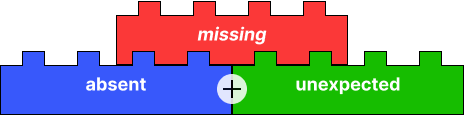
Lexonomy is...
- A hierarchical dictionary...
... founded on the principle that any concept in the
developing mind can be 'defined' by two other terms, one that is
broader and one that qualifies the broader term.
- A crowd-curated, completely unmediated web app, lexonomy.org:
The web app is completely open (no registration of any
sort), and completely unmediated. Any user can create and edit
the parent-child hierarchy and the qualifier words that comprise the
dictionary. Only the complete removal of terms from the dictionary
is protected (by administrative password). Note that public users
can, however, delete 'relationships' between terms because
this is key to crowd-sourcing the curation.
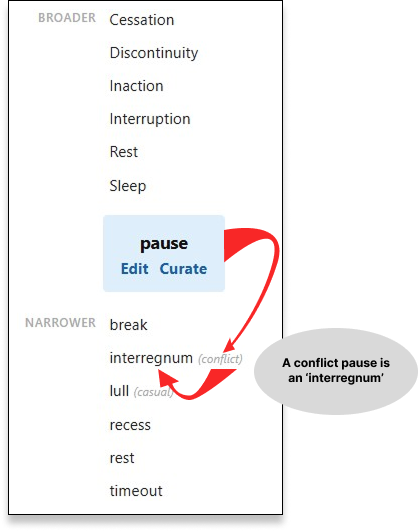
As a lookup tool, Lexonomy.org enables you to look up broader (less
specific) and narrower (more specific) words for a given term. For
instance, if you recall that there's a special word for a 'pause' in a
conflict, but can't remember it, you could look up 'pause' and see more
specialized terms:
Discoveries and Principles
The seed for Lexonomy was planted in 1983
(more below), had fits-and-starts in 2019, and the software
implementation became a reality only with the help of artificial
intelligence, from March to May of 2026. In
the course of the creation, many observations and discoveries arose:
- The Development of Human
Vocabulary
As the system was developed, it became clear that the primary
mechanism of Lexonomy—concepts refining from one to another—was
nothing less than the mechanism of the growth of vocabulary in the
individual, developing human.
- Primes and Primitives
Semantic
primes (also known as conceptual primitives) are a foundational
concept in linguistics pioneered by Anna Wierzbicka and her colleague
Cliff Goddard in 1972. Lexonomy arrives at a list with overlaps but a
very different character: 13 words upon which all other language is
derived: the 5 human senses, the 6 "W" questions, and the words 'yes'
and 'no.'
- The First Word:
'no'
Preceding the software development, the discovery arose that the first
word in human vocabulary—perhaps communication in all entities born of
DNA—is 'no.'
- The First Concept:
'yes'
If a concept is the joining of two terms, then 'yes' was the first
concept, wherein the brain learned the trick of abstraction...
separating one thing from another... subtraction... the act of
'not'... on the notion of 'no' itself. And everything else in the mind
might be explained as extension of this negation trick.
- Lexonomy Describes the Middleground of Vocabulary
At the root of the tree, prime
terms belong to sensory input (smell...) and the cosmos (time,
space, existence), and the mind works from there, combining terms in a
somewhat tree-like simplicity. At the outer reaches of abstraction the
relationships are as if multi-dimensional and richly intertwined. At
that level everything is likely connected to everything, and the
clarity of 'concept=broader(qualifier)' dissolves to "concept=concept
X concept," more of a 'product' relationship than a superset/subset
one.
- True Synonyms
Lexonomy seems to reveal that true synonyms—words that are completely
interchangeable to the point that even when used in a college essay a
professor couldn't objectively argue betwen the two—are fairly rare.
For instance, 'yearly' and 'annual' don't seem to have any breathing
room between them, do they? Well, in fact, you wouldn't expect to see
an 'annual report' entitled 'yearly report,' would you. So, while it
might be difficult to find a qualifier that sliced neatly between the
two (other than perhaps 'formal'?)... they are not absolute synonyms
in the world of Lexonomy.
- Polysemy... and Lexonomy's More Rigorous 'Lexophone'
In lingustics, the various senses of the word 'head' (physical
body part, company leader, unit of livestock) are called polysemy (for
multiple semantics) and have various definitions in dictionary. In
Lexonomy, these three uses of the term are the same (!) concept. But
consider two identically spelled words with thoroughly disconnected
meanings, such as 'mole' (the animal), and 'mole' (the chemical
measurement term). These two meanings were never connected in any way.
But other instances had a connection at one time and that connection has
dissolved completely over time. An example is 'fluke' (chance event, vs
whale's tail). Apparently 'chance event' did evolve from an old idiom
that invoked the whale's tail. But no connection is currenly
perceivable, and no child could ever evolve one from the other! Both are
polysemy with nary a trace of formative derivation. They are lexophones,
with 'mole' being even more pure than 'fluke.'
- Lexoneme... the Smallest Space Between Concepts
Is 'mismatch' a pure synonym for 'disagreement'? In a conversation, I
stated that there was a 'disagreement' between two sets of values. AI
came back with a response about the 'mismatch.' And I immediately
focused on the nuance between the two terms: disagreement implies
action, or an actor, or an act; mismatch makes no such association and
was the more correct term. This small gap, 'near rungs' on a ladder, I'm
calling a 'lexoneme,' a pair of words with just the slightest
qualification between them, one that Lexonomy strives to identify.
- Lexonomy Doesn't Explain Nature or Man-Made Terms
Those are simply not concepts, even if they often develop corresponding
terms that are indeed conceptual. The are not the combining of two
things in the brain. A 'frog' cannot be reduced to two existing terms;
it might be a type of amphbian, but it is not uniquely distinguished
from other amphibians by a single term. So too, with man's creations.
- Lexon... Concept from the Un-Conceptual
The word 'hammer' refers (first-and-foremost?) to the physical
tool, but it is clearly a prominent member of conceptual space. We're
using the term 'lexon' to denote such terms, whether man-made or
nature-made, that gain conceptual standing.
What
- A crowd-sourced, hierarchical dictionary.
- Lexonomy is founded on a bold concept that any word can be identified
by as few as two other words. One of those two words is a more general
term, and one is a term that qualifies that more general term. So in the
general topic of 'stop' there might be two, more specific terms, 'pause'
and 'end.' A very specific word, 'interregnum' is based on the term
'pause,' with the qualifier 'conflict,' as shown above. Thus,
"interregnum = conflict pause."
- Seeded with words from Roget's Thesaurus. We didn't use all of them
since there's a lot of arcana, but it's a useful starting point.
- You can look up words, or contribute to the dictionary with these
options:
- Quick Add: a simple page with three fields to enter any new entry
into the dictionary, specifically intended for phone use.
- Edit: a more complex page for entering broader and narrower terms,
and fits on a phone, but serious contributing should really be done
on a full-screen desktop with the next two options.
- Curate: a drag-and-drop categorizing tool to organize the
hierarchy of a term. This is generally used on whole topics from
Roget's Thesaurus, which range from 10-50 words.
- Inheritance: the equivalent of Curate, but a 3-column tool that's
not as quick and visual as Curate, but lets you build one level
deeper of word nesting.
Who
- Lexonomy was created by Jack Bellis, of Philadelphia, PA USA, with...
- Software development 100% by Claude.ai of
Anthropic.com. I had to direct Claude, move files, deploy, and massage
the database, but Claude did every line of code. More, below, in 'How.'
- Peter Mark Roget (1779–1869), author of Roget's
Thesaurus. More, below, in 'How.'
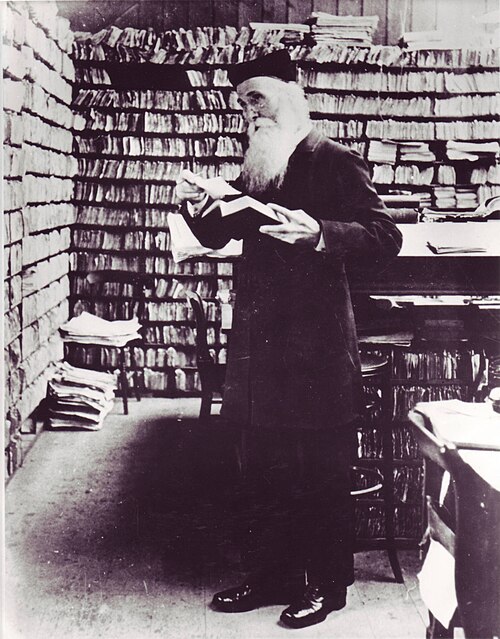
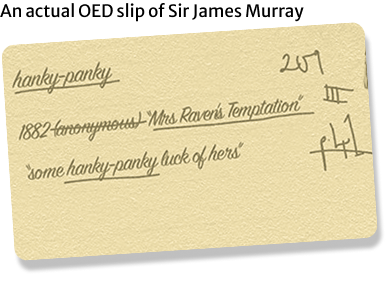
- Sir James Murray (1837-1915) (image at end), who
created the Oxford English Dictionary. His methodology of collecting
slips of paper (image at end), each with substantiation for the usage of
a word, is part and parcel of our concept... soliciting teeny-weenie
contributions that build our corpus.
- Anna Wierzbicka and her colleague Cliff Goddard, who
in 1972, formalized the concept of Semantic
primes.
- I am humbled and amazed to see in the Wikipedia accounting of the
thesaurus, that I am following, in turn with Roget, on the work
apparently of Liebniz and Aristotle.
Sir James Murray with his collection of slips:
Where
Why
- Now it gets interesting. At some point I started noticing that the
meanings of words are hierarchical. I can recall at one time, in my
techwriting years, noticing that it was important to properly choose
between the words 'tap,' 'click,' 'choose,' and 'select'... and that
some were too specific... and that the broader ones were sometimes
broader even than one another. I don't know if that's the earliest time
this happened, but it's one of the first.
- Eventually, doing many crossword puzzles, I noticed
the wonderful economy of words in the clues. Complex terms were often
reduced to one or two other words. When a clue is one word, it's
probably just a synonym, nothing enlightening there. But two-word clues
reveal a pattern, or at least beg a question: can any term be targeted
by two words? If they're hierarchical, sure. Any word is the 'product
of' a more general word and some word that qualifies it to a more
specific use. Surely the human brain must need some sort of scaffolding
on which to organize this massive jumble of terms that we deploy so
precisely to slice-and-dice the world of our thoughts, which we then
spill out onto pixels and ink.
- This eventually became Bellis's Law: any word can be identified by two
other words, a broader term and a qualifier. The pieces of this triad,
"term = [broad term], [qualifier]" I'm calling 'cepts,' suggested by the
constituent part of the word con-cept, to bring together two ideas. The
Lexonomy is unavoidably visualized as a simple multi-level outline of
words, as shown above in the Lookup example. But the human brain is so
richly networked, that every "term" in my little equation, above,
becomes a broader term and/or a qualifier. So 'cept' is a bit of a
fleeting notion... one term's qualifier becomes another term's broader.
But let's move on.
- Why not just ask Google? You could, and still might. But Lexonomy lets
you browse every which way among the mental space of any concept.
When
- I started trying to make Lexonomy in 2010, manually extracting the
public domain content of Roget's Thesaurus, chopping its 700 or so
topics apart and arranging them into a Google "site," where I was
surprised (now in 2026) to see that the content is still present. I
realized it was pointless. Lexonomy
as a dot-com URL was taken so started using the term 'coeptonomy,'
using the 'cept' part of concept but somehow getting the idea that
adding an 'o' made it suggestive of something erudite(?!).
- And then in February of 2026 I started experimenting with AI,
Claude.ai, to be specific. From extensive
experiments with Claude, it became clear to me that he was
superintelligent—I have zero trouble making that assessment— superfast,
superprogrammer. And it took me weeks, but I finally asked myself,
"can't I use Claude to make Lexonomy?" I believe it took 3 weeks, and
about 200 prompts... and he did.
- In my lengthy discussions with Claude, which I've offloaded from
Claude.ai for posterity, we discovered that the inspiration for Lexonomy
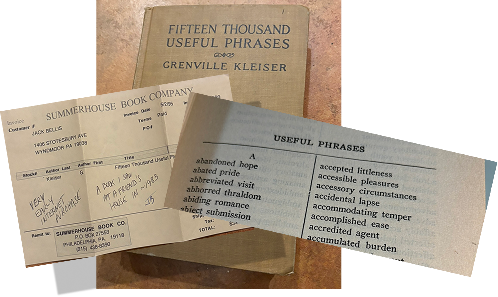
goes even further back. I proposed further seeding Lexonomy with a list
of two-word phrases from another word book, Grenville Kleiser's Fifteen
Thousand Useful Phrases (image at end). I left my receipt in that book,
and it's from May 2, 1995. It was just after the World Wide Web was
getting up to speed. And that in turn meant that you could type into it
almost anything, such as a book title you've always wondered about, and
maybe learn about it or even buy it. Well I did buy it, because I'd been
fascinated about that book after pulling it off of a bookshelp at a
friend's house, and always remembered the name. And on a hand-written
note on that very receipt, from Summerhouse Book Company in
Philadelphia, I wrote "Very early internet purchase, a book I saw
at a friend's house in 1983."
The book that might have planted the seed for a hierarchical dictionary,
Lexonomy, with my 1983 recollection:
- I have no idea how long it took me to start formulating my law of
two-word definitions, after getting transfixed by Kleiser's 45 pages (!)
of two-word 'useful phrases,' but it's entirely reasonable to think of
1983 as the year that Lexonomy started. Maybe the seedling hadn't even
sprouted, but the land was starting to be cultivated. Forty-three years,
that's when Lexonomy started... and Claude essentially built it in 3
weeks.
How
- The public domain contents of the thesaurus was ingested
by Claude and extensively filtered and cleaned up to seed a good
starting point for Lexonomy, rather than asking 'the crowd' to start
from a blank slate.
- Roget had about 1000 groups of terms, which Lexonomy calls categories,
and three levels of categorization above these terms. The categories
would have gotten in the way of crowdsourcing the hierarchy so that
level was omitted; none of Roget's classes,
subclasses, or numbered section headings are in Lexonomy. Claude also
recommended, and I took his recommendation to strip out lots of arcana
(rackabones?), phrases, Latin, and so on.
- AI Curation: I was going to rely only on
crowdsourcing for the broader/narrower relationships, but then I
realized... hold on a second, isn't Claude pretty good with language? So
I asked Claude about taking a pass at creating the broader/narrower
relationships and he literally said, "just ask." So I had him do it, and
there are now crude groupings within almost every one of our 700
categories. It was amazing to see. This brings up the question...
- Why not just have AI totally create the hierarchy?
- Claude Conversation Instances: The first two Claude conversations
lasted almost two weeks each, totalling 122,000 words. The first one
started to slow down under its own weight. Apparently each instance
maintains an ongoing context, which in turn does amount to familiarity
with the project and resembles a definite nuance of comprehension that
has to be reconstructed in a new instance. The first instance provided a
lengthy "transfer of knowledge" project summary which was then pasted
into the second instance, along with the few HTML and JS files that the
first instance created. The second instance had zero trouble picking up
where it was left off. The whole thing was as staggeringly impressive as
my
previous experiments with Claude. I'll be writing up an extensive
article on the experience of creating Lexonomy with Claude. At this
writing, I'm in 'Claude 49'... yes, the 49th conversation instance.
- Resulting Web App: The result is an app that
- Phone users can use to look up terms. It's already rich with one
flat level of synonyms and Claude's pass at creating hierarchy
within them. A quick look at his groupings seems to show that the
human touch can add a lot. I'll have to evaluate more.
- Quick Add: a phone page on which you can submit an entry to
Lexonomy. And when I say "submit," I mean include on the fly with no
moderator in the middle. Each entry you make, of
term/broader/qualifier is the modern, Lexonomy equivalent of one the
the Oxford English Dictionary's (OED) 'slips' (image at end) from
which Sir Murray created the OED. So we call each submission—each
row in the database—a Murray Slip! And you created
it!
- Curation: Serious curation can be done on a large screen. The
drag-and-drop is pretty cool, mostly in the tree.
- Games: There are 6 games you can play to help curate Lexonomy,
deciding on best qualifiers, reconciling competing opinions and so
on. They're a challengine alternative to Wordle for people who want
to do a puzzle where the answer is only in one's on brain.
An actual Sir James Murray OED slip. This is what one of Murray's
3.5 million slips looks like:
How Much
- Free, other than the cost of getting on the Web.
- No spam, currently no login, no password, no secret handshake, no
nothin. If it gets trashed I'll do a restore and do what has to be done.
'Under the Hood'
Lexonomy uses a simple database that is fundamentally 3 fields:
- Parent Term
- Term
- Qualifier
There are several other fields that manage the game outputs when a
worklist item is created, and disposition of wrorklist items but they have
no influence on the dictionary, so to speak. In other words, the theory is
captured very purely by the 'schema' to use the technical word. There are
only these contrivances:
- Orphans: The pseudo-value '[orphan]' is placed in the
Parent Term field when a user performs an action that would completely
remove the last occurence of a term from Lexonomy, whether that term was
used as a parent or term or qualifier. These orphans appear in the
Orphans worklist for anyone to place in a good home, whether foster care
or permanent.
- Variants
- Variant is the term used as a catchall for words
that are the identical concept as another term but have not yet been
more carefully identified with one of the following choices.
- Synonyms: the pseudo-value [synonym] is placed in
the qualifier field when users deem a term to be completely
interchangeable with another. The system arbitrarily regards one
term in a synonym relationship as the parent... simply based on what
term happened to be the term being edited or curated... the 'main
term' one might say. So if I'm working on 'blend' and see 'mix' as
one of its children/narrower terms, I might decide they're synonyms
(I emphasize, completely interchangeable), I can choose the
autosuggested choice [synonym] for 'mix's qualifier. Thereafter,
'blend' is the parent, but only arbitrarily so, by virtue of editing
order. Note that synonyms shouldn't have children... because their
existence would imply a distinction from their counterpart, a
distinction that surely must reveal a strong qualifier that could be
identified.
- Nouns, Adjectives, etc: In general, it's better
to declare different parts of speech simply as one of these variants
rather than a separate concept. How do we make the choice, when to
provide some other qualifier than simply [noun], for instance? I
don't have an exact answer, but it might be a moot point. The
question is actually only, do you have a better qualifier??? Nouns
and adjectives can have their own children... whereas synonyms
shouldn't.
- Not: Ah, the real troublemaker. Lexonomy has as
its theoretical foundation that 'no' is the fundamental operation
that starts vocabulary development in the growing mind. And Claude
insists (don't laugh) that negation is the soul of vocabulary
propagation (my words, his observation). Anyway, somewhere
approaching 50% of—but I guarantee you not exceeding—vocabulary is
probably just the negation of the other near half. In Lexonomy,
opposites, antonyms, are the same concept... in a way. Lexonomy has
no answer for this antimatter capability of the brain. It's
automatic. It's the magic qualifier, the super qualifier. But at the
outer reaches of the tree of words that Lexonomy proposes, the brain
automatically uses every word (!) as a qualifier for every other
word. That, just like the enormity of data centers proliferating
right now in 2026, is probably the miracle of human-like thought.
Assign '[not]' whereever you deem it the right qualifier... but
don't remove antonyms from a concept just because they look like
invaders... they're not.
Roget vs. Lexonomy
Roget produced a book of 1042 topics, each with dozens to hundreds of
terms. (In Lexonomy, we've settled on calling those original topics
'categories.') And he did have hierarchy, but it was totally about
abstraction, whereas Lexonomy is all about development of concepts in the
brain.
And Roget did have hierarchy, 6 levels, in fact... as you can see below.
But it was all about the general commonality between the words, then down
to parts of speech. Here is his first entry:
| 1 |
Class |
CLASS I: WORDS EXPRESSING ABSTRACT RELATIONS |
| 2 |
Section |
SECTION I. EXISTENCE |
| 3 |
Subsection |
1.BEING, IN THE ABSTRACT |
| 4 |
Category |
#1. Existence |
| 5 |
Part of Speech |
N. existence, being, entity, ens...
494 actual existence. presence &c. (existence
in space)
186 coexistence &c.
V. exist, be; have being...
Adj. existing &c. v.; existent, under the sun;...
Adv. actually &c. adj.; in fact, in point of fact,...
Phr. ens rationis [Lat.]; ergo sum cogito [Lat.],...
|
| 6 |
Cross-refs |
(the 494 and 186, above) |
So where Roget will have ...
- #906. Benevolence —
N. benevolence, Christian charity; God's love,
God's grace; good will; philanthropy &c.
910 unselfishness &c.
942 good nature, good feeling, good wishes; kindness,
kindliness &c. adj.; loving-kindness,
benignity, ...
... Lexonomy is about developmental
genealogy, looking for the simplest word in such a group that a child
might learn first, and then deriving more and more sophisticated terms.
Our tree might have this progression:
- good
- kind
- unselfish
- charity
- benevolent
- generosity
- altruist
So in Lexonomy, "benevolence" is hardly a top-level term... it is
developed over years of language learning from infancy to perhaps young
adulthood. And note that Lexonomy will generally use the verb and
adjective forms. Nouns are more of an abstraction, somewhat of an extreme
accomplishment of the human brain. The actions and descriptions
(adjectives) are closer to the root of our tree.
Synonyms, Antonyms, Nature, and Parts-of-Speech
- Parts-of-speech: when you enter qualifiers, you
may wonder if you're supposed to use adjectives or nouns, or whatever...
or try to re-use existing qualifier spellings, that sort of thing. And
that's good instinct. But our design decision when creating
Lexonomy was that parts of speech should be de-emphasized when they
don't result in significantly separate meanings. Lexonomy is about
concepts. Parts of speech are sometimes just a variant on any concept.
(One could say that the noun for any concept is that concept qualified
by 'thing.' And the verb for any concept is that concept qualifed by
'do.') Claude.ai has done two different passes through Roget's
original set of words, and on the second pass used the qualifier,
"nominal" to identify the noun form of verbs. Sometimes the noun form
has a broad ontology of new senses of a word. For instance "motion" vs.
"move" has a rich catalog of meanings, so in this case "part of speech"
is important and valuable. In other cases it might not be as
significant. Just enter whatever occurs to you as the right
way to qualify something, without excessive regard for
part-of-speech. I fully expect to have AI try to clean that up later...
seriously. Claude and I talked about it and he's optimistic. In fact,
since AI is founded first-and-foremost I seem to understand, it is words
(not software code) that is—or should be—AI's strength. It certainly
will have the speed required to review tens of thousands of sloppy,
human words and disambiguate them.
- Nouns vs Adjectives and Verbs: Roget's categories,
which seed Lexonomy, are almost all phrased as nouns — 'youth' instead
of 'young,' 'cessation' instead of 'stop.' Lexonomy leans toward
adjective and verb forms. The reason is subtle: young is closer to lived
experience than youth. Youth is a categorization — one step of
abstraction away from life. Lexonomy is organized around how meaning
forms in the mind, which is from living outward, not from categories
inward.
- Synonyms: if all goes as planned, synonyms
are simply words with identical parents and no difference in
qualifiers. I suppose that means either no qualifiers or
identical qualifiers. (Hmmm, did we account for similar qualifiers?
Don't know.) A lot of things will be learned about our Lookup logic and
functionality after some beta usage. In Lexonomy we don't really try to
claim that any two terms are synonyms, instead leaving that to the
dictionary folks. It's as if we're saying "all we have here is evidence,
not a verdict." Notice I said "if all goes as planned."
- Antonyms: again, if all goes as planned, antonyms
will be built into the Lexonomy premise itself: they will be
the qualification of any concept by the word "not". Let's see
how THAT works out! So we shouldn't have to provide any instruction or
rules to follow. Maybe like qualifiers, Claude will at some future time
clean up all entries of the qualifiers 'no' and 'not' to all say 'no.'
- Natural Objects are not subject to the whims of
Lexonomy. The many-leveled taxonomy of the natural world is much deeper
than any of us are likely to categorize any of our concepts. And I have
thought through trying to find a 'crossword' (two-word) combination to
identify various species, and it doesn't work. Consider 'elephant.'
Tusked beast? That could be a rhino. They are not human contrivances,
not concepts. 'Nuff said.
Prime Words
If words are in fact hierarchical, with parent-child relationships, then
some words must be at the top of the genealogy, right? That's my theory,
and I call them 'prime word,' analogous to prime numbers. They are words
that are not able to be expressed clearly relative to a broader term.
Children learn them mostly by example, but that's how they learn almost
all words, so that's probably just an interesting observation. Attempts to
define them usually go in linguistic circles... but that's fine... that's
what the brain is all about.
My Original Guess at Primes, 2019
Here's my list of prime words, formulated in approximately 2019 when I
first tried manually curating a hierarchy in Google Sites:
| a |
feel |
me |
see |
| about |
for |
my |
so |
| and |
from |
no |
than |
| answer |
good/bad |
not |
their |
| as |
happen |
of |
then |
| at |
have |
off |
thing |
| big/small |
hear |
or |
way |
| but |
I |
part |
weather |
| by |
if |
place |
when |
| can |
is |
question |
which |
| do |
like |
same/different |
you |
The 13 Primes, After Lexonomy Matured, 2026
The following diagram shows the primes and primitives derived from
Lexonomy, thinking through the likely mechanism of development of the
earliest vocabulary terms... based on imagining a parent's words to a
newborn.
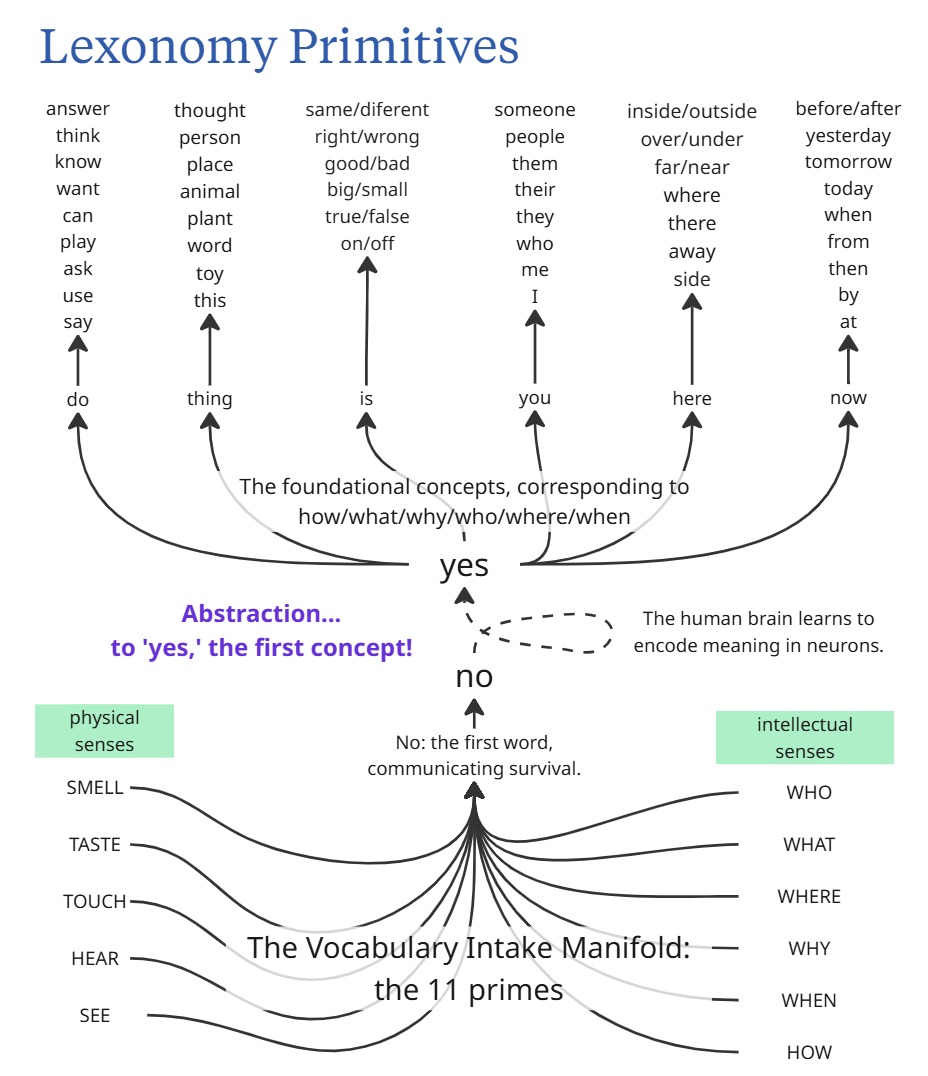
Notice the green highlights, where the mind 'bottoms out' at the physical
world. There are the 5 traditional senses
- smell
- taste
- touch
- see
- hear...
and the classical questions that each has a more abstract word in the
mature mind:
- do (how?)
- thing (what?)
- be (why?)
- you (who?)
- here (where?)
- now (when?).
To these 11 Lexonomy adds...
- the first word, 'no,' and
- the first concept, 'yes,' both of which get emeritus status in the
list of primes.
That's the list of primes—true primes—according to Lexonomy. Only 13
terms that defy decomposition. Even seemingly cloud-like words such as
'by' can be factored, under enough curatorial pressure, into, for
instance: by=when(must). even the seemingly (!) unsophisticated toddler
brain is taking the thousands of times it hears 'by,' and realizing that
it concerns matters of 'when' (whether with a sense of time or condition
[if]), and combines it with matters of "necessity."
Everything beyond the 13 primes is a matter of abstraction through
combination.
Semantic Primitives: Wierzbicka (1972) vs Bellis
Wierzbicka et al started with 14 primes/primitives. In Lexonomy, I
arrived eventually at 13... corresponding to the 5 human senses, and the
traditional "who/what/where..." questions, and the first word ('no'), and
first concept ('yes'). How do they compare?
A structural comparison of two independently-derived
primitive sets exact / direct near match only in
Wierzbicka only in Bellis
| Wierzbicka 1972 |
Lexonomy |
Comments |
| 'you' |
Exact
match |
A
mother's most frequently repeated first word? No mystery we
overlap even with different foundations. |
| 'say' |
1 level
different |
In Lexonomy, but
1 level abstracted: 'do'>'say'. |
| 'good' |
1
level different |
In Lexonomy, but
1 level abstracted: 'be'>'good'. |
| 'want/not want' |
1
level different |
In Lexonomy, but one level
abstracted: 'do'>'want'. |
| 'think of' |
1
level different |
In Lexonomy, but
1 level abstracted: (from 'do'>'think') |
| 'this' |
1
level different |
In
Lexonomy, but one level abstracted, 'thing'>'this'. |
| 'become' |
'be' |
Agreement
in principle, but not term. Lexonomy believes a child learns
'become' much later. |
| 'I' |
2 levels
different |
2
levels abstracted (from 'you'>'me'>'I'). Lexonomy tries to
identify a child's first words. As such, 'you' is the root of this
line of cognition (who)—of modeling the curious world—and a child
develops the vocabulary word for oneself ('I') significantly
later... deriving it from 'you.' |
| 'someone' |
2 levels
different |
Lexonomy
originally had 'someone' one step up from 'you' in the 'who'
branch of the tree, but then relegated it to a longer list of
terms derived from people, or whatever term a child might first
develop for the 'third person' collectively:
'you'>'people'>'someone'. |
| 'part of' |
2 levels
different ('part') |
Lexonomy
has 'thing'>'this'>'part'. |
| 'something' |
2 levels different
('thing') |
Match
in principle, but Lexonomy presumes the shorter word must be
learned first. |
| 'like' |
<not
included> |
Lexonomy
dropped 'feel' (catch-all for emotions) from its prime/primitives
tree late in the game, after noticing that emotions might
correspond to 'thinking' that has persistence or even 'residue,'
as the term originally came up in a discussion with Claude. As
such 'like' is not currently on our diagram even though a mother
asks a child 'like' questions from the moment of birth. |
| 'imagine' |
<not
included> |
Very
different interpretation... an infant might start imagining
even in the womb, but their vocabulary doesn't articulate
such a notion for quite some time. |
| <not
included> |
'do' |
One
of Lexonomy's core observations... the primacy of motion or action
as the innate origin of animality — the organism acts
before it speaks or thinks. |
| <not
included> |
here |
Only
in Lexonomy. |
| <not
included> |
now |
Only in Lexonomy. |
| <not
included> |
'no' |
Very
different. 'No' has a special place in Lexonomy, proposed as the
original mechanism of abstraction by which the brain learns
abstraction. |
| 'see'
and 'hear' added to 1972 list in 1989 |
see, hear, touch, smell,
taste |
Lexonomy treats
all five as input channels from the start, arrived at by
architectural reasoning rather than their resistance to being
defined. |
Key structural difference: Wierzbicka's method is
reductive paraphrase — primitives are discovered when definitions fail.
Bellis's method is architectural — primitives are the irreducible modes of
contact between organism and world. Wierzbicka's list is the
primitives of a speaking mind; Lexonomy's are the
primitives of an organism.
Primes vs. Primitives
To me, it can be an objective matter what constitutes a 'prime'... a word
that is indivisible by others... simply cannot be factored. And Lexonomy
declares 13. But 'primitive,' which sounds one degree less absolute, seems
less objective after working through many decompositions in the course of
working on Lexonomy and curating its tree. Clearly some words are more
basic than, for instance 'personality,' or 'obfuscation.' But where is the
line between 'person' and 'individual'? I think that 'primitive' is just a
qualitative judgment.
Decomposing (Factoring) the Connector Words
Among the primitives, whether from my notions of such a list, or
Wierzbicka or others, there are these troublesome, short little words like
'and' and 'for'... that seem immune to curation. But as my pencil has
gotten sharper, I've started to work out how some of them might be
qualified, built upon other early words.
Subsets versus Products And it seems that there's a bit
of a difference between Lexonomy's general notion of qualification as
'subsetting,' and how these connector words are construed in the mind.
They seem to be more like 'products' of two factors, moreso than a
narrowing from one idea to another. And that same phenomenon, products
versus subsets, seems like it might be the case as the vocabulary
matures... toward the outer edge of the mental corpus (not my word,
Claude's)... where terms are endlessly intertwined moreso than
neat-and-simple two-dimensional sets.
If you'll refer to our Primitives Diagram,
here's what I've worked out:
From the 'thing' Branch of Primes
| this |
= [thing (here)] |
| a |
= [thing (any)] |
| the |
= [a (one)] |
| than |
= [thing (not)] |
| one |
= [a (only)] |
| and |
= [this (this)] |
| as |
= [thing (of)] |
| all |
= [thing (every)] |
| of |
= [thing (this)] |
I'm
especially proud of 'the' turning out to be 'a (one)'... a play-on-words
of the idiom A-one, altogether appropriate for the appelation (?),
'the,' denoting not just any entity, but the preeminent one.
From
the 'be' Branch of Primes
| if |
= be (is) |
| or |
= be (not) |
| so |
= be (can) |
| but |
= be (if) |
| why |
= be (think) |
| else |
= if (not) |
| have |
= here (thing) |
| because |
= is (why) |
| happen |
= is (do) |
| maybe |
= is (if) |
From the 'now' Branch of Primes
| at |
= when (be) |
| by |
= when (must) |
| then |
= when (if) |
| from |
= where (be) |
| when |
= now (not) |
Game Logic
There are 6 games and 3 of them directly create worklists items if your
answer leaves some sort of loose end, or undecided matter, such as two
different opinions on a qualifier. A fourth game will also result in a
worklist item in the Orphans worklist, if the action you took would result
in the removal of the very last instance of a term in Lexonomy.
The following topics describe the games technical aspects.
Qualify
Pool Source
All concept where the qualifier = '' and session_id
does not start with play_. No worklist column filter.
Screen options
- Text input + Submit — player types a qualifying word
(typeahead wired)
- [variant] → dropdown — expands to: noun / verb /
adjective / adverb / not / synonym / variant (unspecified). Each saves a
bracketed qualifier.
- Skip — no action
Worklist impact: none. No column stamped.
Current size: Enormous. The vast majority of slips carry
no qualifier at all (empty string). Bracket-qualified slips ([noun],
[n/a], [synonym], etc.) are excluded — they're
treated as resolved. Will outlast every other pool by years.
Depletion: Drains as qualifiers are entered via game
votes or Build/Edit. No floor — new slips added without qualifiers
re-enter the pool immediately.
Replenishment: Any new unqualified slip is eligible.
Note: Inversely correlated with Specify — as Qualify
shrinks, Specify grows. The two pools trade mass as the corpus matures.
Parent
Pool Source
All concepts where session_id starts with
ai_, roget, roget_clean, or roget_hier,
and gm_parent IS NULL. Human-entered slips
excluded. Shuffled.
Screen options
- ✓ Looks right — relationship confirmed
- ✗ Wrong parent → reveals sub-options:
- Reverse the direction
- ≈ Synonym of parent — marks as synonym, keeps
slip with
qualifier='[synonym]'
- No relation — remove the relationship
- Skip or Not Applicable
- Skip (main screen)
Worklist impact: Deleted concepts may create Immaculate
Concept-ion worklist items (items that have no broader term pointing to
them).
Current size: Finite. Only ai_, roget,
roget_clean, roget_hier slips with gm_parent
IS NULL are eligible. Human-entered slips never enter this pool.
Depletion: Drains permanently as slips are confirmed,
reversed, or removed. Once all Roget/AI-origin slips are reviewed, this
pool is permanently empty until the next AI import
batch.
Replenishment: None without a new import. This is the
only pool with a definite terminus.
Gap
Pool Source
All concepts with 5+ children. One child
selected at random per qualifying parent. Excludes slips where gm_gap
= 'direct' or gm_gap = 'gap_flagged'. Shuffled.
Screen Options
- Direct is right — no intermediate needed
- Needs a step — flags this pair as having a gap
- Skip
Worklist impact: gm_gap = 'gap_flagged'
feeds Parent-Child Gaps worklist. Both 'direct' and 'gap_flagged'
excluded from game pool.
Current size: One entry per parent with 5+ children (one
random child selected per qualifying parent at build time).
Depletion: Acting on one child stamps that slip and
excludes it from the pool, but the parent remains eligible until all its
children are stamped. Pool grows with corpus as new parents reach the
5-child threshold.
Replenishment: Self-replenishing. New slips added under
qualifying parents enter immediately.
Symilar
Pool Source
Children of the same parent where: both words are childless,
both slips are unqualified (qualifier = '' or identical
qualifier) under that parent, and gm_symilar IS NULL. Groups
by parent + qualifier. Pairs capped at 4 per parent, 200
total. Shuffled.
Screen Options
- ✓ Yes — same thing — fully interchangeable
- ✗ No — they're distinct — meaningful difference
exists
- Skip
Worklist impact: "No" feeds the Needs Qualifier
worklist.
Current size: Capped at 200 pairs. Currently moderate —
depends on how many childless co-children share a parent without
qualifiers.
Depletion: gm_symilar stamps drain pairs.
Also shrinks indirectly as Qualify game adds qualifiers, which groups
co-children more specifically and reduces pairing candidates.
Replenishment: New unqualified slips under the same
parent regenerate pairs. Inversely correlated with qualifier density.
Specify
Pool Source
All concepts where qualifier is non-empty and non-bracket, gm_specify
IS NULL, play_ excluded, and the parent has 3+
other children to serve as distractors. Player is shown the
parent and qualifier and must identify the correct child from
choices.
Screen options
- [child word buttons] — player taps what they think
the qualifier points to
- Correct — auto-advances after 2s (or tap Next)
- Incorrect — shows "Added to Difficult Qualifiers
worklist"; Continue button
- ✗ They're all bad — none of the choices are right;
qualifier itself is problematic
- Skip
Worklist impact: Wrong pick feeds the Difficult
Qualifiers worklist.
Current size: Currently thin — requires qualified,
non-bracket slips with 3+ siblings as distractors. Few such slips exist
early in curation.
Depletion: gm_specify stamps drain eligible
slips.
Replenishment: Grows directly as the Qualify pool
shrinks. Every new qualifier added creates a potential Specify candidate.
This pool becomes dominant mid-curation.
Misfit
Pool Source
Concepts with 3+ children, excluding parents
already acted on this session (misfitActedParents), excluding
child–parent pairs where gm_misfit IS NOT NULL. Up to 5
children shown per parent. Shuffled.
Screen options
- [child word buttons] — player taps which child
doesn't belong
- None — they all fit — stamps all children as reviewed
- Skip
Last-instance check: after player picks a word, asgn
is scanned for any other slip where the word appears as child (a)
or parent (b), excluding the current slip. If none found —
last-instance path taken.
Worklist impact: Last-instance picks feed
the Orphans worklist.
Current size: Large and persistent. Any parent with 3+
children qualifies; corpus currently has many such parents.
Depletion: gm_misfit stamps on individual
child–parent pairs provide durable exclusion. misfitActedParents
(session-only) is the short-term exclusion — it resets on every page
reload.
Replenishment: Hardest pool to exhaust. Acted parents
re-enter the pool on reload unless every child carries a gm_misfit
stamp. Grows with corpus.
So Use It!
It's in its nascent › early › new days so the lookup is only as good as
the few entries that have been submitted. But in exchange for that
newness, you can take pride in being an early contributor. At this point,
pride alone will have to be your reward — I don't want to slow it down
with registration or tying user identity to specific curation.
Instructions/User Manual
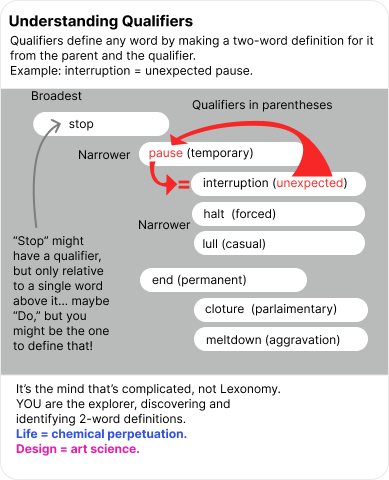
Qualifiers and Broader/Narrower, Part 1
There are two parts to the magic of Lexonomy:
- Declaring that one term is broader/narrower than another.
- Finding a word to describe that relationship
Keep saying this to yourself, as I had to making this
whole system: if it were easy anyone could do it.
Qualifiers and Broader/Narrower, Part 2: A Great
Example
Bland, boring, tedious: how do you put this into Lexonomy? An early
tester tried to put this into Lexonomy.
- First ask yourself, which of the three is the broadest?
- Let's put it this way: which of the three would a child learn
first? Boring!
- Pretty obvious once you think of it. No kid learns 'bland' or
'tedious' early, but they do learn borrrr-ing.
Next, are tedious and bland part of the same family... related... same
general idea? Yes they are. Roget thought they were and put them in
a category, I think.
Next, how would you qualify or narrow boring to get to bland? What
would a crossword-puzzle, two-word clue be to get you to
bland... but using boring??? 'Boring taste' or 'boring flavor.' Let's
arbitrarily choose 'flavor.' So the qualifier is 'flavor.'
Bland= boring flavor. Would someone get the answer in a crossword puzzle?
I think they would.
And 'tedious'? How would you qualify boring to get to tedious? 'Labor' or
'effort'... boring labor, boring effort... maybe 'work'... boring work.
- Which two-word clue would be best in a crossword?
Boring work.
- Imagine you're writing a book of some other message, would
you really use the two words interchangeably? Always a
possibility... don't talk yourself into qualifiers.
- If not, when would
Tedious= boring work.
But Lexonomy is democratic. Perhaps you have THE right answer.
Avatars and Visitors
Lexonomy does not require creating an account or logging in. Our goal,
until proven impractical, is to allow anonymous and completely free
editing, other than deletions, which are protected with a password. Email
me jackbellis@hotmail.com if
you'd like the password. In exchange for this openness, there's no
contribution tracking, only a randomly generated avatar name for each
visitor. Like some other web systems that have public data that might be
associated with a person or business, we allow you to 'claim' your avatar,
which simply means entering any information you'd like... to identify
yourself. It's one simple text input box with no rules. You can enter your
genuine contact information such as an email or website, or just a note to
inform others who you are. Offensive information will be deleted.
Claiming your avatar: Click the avatar name in the
toolbar at the top of the screen.
Listing visitors who have claimed their
avatar: Click the avatar name in the toolbar at the top of the
screen.
Technical Implementation
How
your Avatar Is Remembered
Your
avatar name is stored in your browser's local storage — a
permanent store that survives page refreshes, tab closes, browser
restarts, and even OS restarts. It is not a cookie, and clearing your
browser cache alone will not affect it.
When
a New Avatar Is Generated
- You
clear your browser's site data (the "local storage" store specifically)
- You
use a different browser on the same machine (Chrome and Firefox each
have their own separate local storage)
- You
use a private / incognito window (local storage is wiped when that
window closes)
- You
visit on a new device or a fresh browser profile
Avatar
Persistence
Avatars
persist across...
- Page
refreshes
- Closing
and reopening the tab or browser
- OS
restarts
- Clearing
the browser cache (cache and local storage are separate stores)
The
3 Storage Levels of Browser Software
| Store |
Lifetime |
Shared across tabs? |
| Local
storage |
Permanent
(until cleared) |
Yes |
| Session
storage |
One
tab, until closed |
No |
| Cache |
Until
cleared or expired |
Yes |
Lookup
- What it does: lets anyone harvest the fruit of Lexonomy's labor.
- If it requires any explanation at all, I have failed.
- Can I blame any of it on Claude... Claude and I have failed??? No,
not really. He did in hours what I have imagined since either 1983
or 2010.
Build
Quick Add
- What it does: enables you to add a new entry to Lexonomy with
the least distraction.
- When/why to use it: on the spur-of-the-moment, on a phone in
particular, when you notice a pair of words that have a relationship and
you think it might not be in Lexonomy already.
- As you type in a field, it will show existing terms.
- Adding a qualifier is often the harder part. See our qualifier help
diagram and section.
Edit
- What it does: enables you to do more extensive additions than the
one-and-done Quick Add but is really a compromise compared to using the
full-screen Curate which shows you very visually the whole set of
relationships in a category.
- When/why to use it: if for some reason you want to do more than
one-word editing and you're not near a desktop.
- To do the initial grouping of
terms in a category, use the full-screen Curate instead.
- Some features require a password because they risk more serious
changes (or loss) of the data. Email me if you're interested.
Game
- What it does: lets you kill time by helping build Lexonomy.
- After 12 game pages or rooms, you get a report on your session showing
decisions you made and how they might have changed the data or added
'to-do' items to worklists. Closing the Complete message just repeats
the cycle.
- Selecting Level Up explains that you can move on to reviewing
worklists and starts you with a fun one, Difficult Qualifiers.
- You can 'pin' any game that you might like, to have it repeat just
that one game.
- After any game page, you can re-visit the terms that were in the
question by looking at Lookup>History. If you wanted to change your
mind, you can click the respective term in History. Worklist items might
stay but there's no harm in that.
Specify Game
The Specify game shows you a term and one of its qualifiers, such as
"practice(repeat)" and asks you to pick which of several possible concepts
are specified by that combination.
- Which term is specified by … image (visual)
- Match: If you click the term already in the database for that
combination, a confirmation message appears and you are advanced to the
next game.
- Difference: If you choose a different term than the one already
'qualified' by 'repeat' (in the example above), your choice gets added
as a work item in the worklist Difficult Qualifiers.
Qualify Game
This game challenges you to do the hardest job in Lexonomy: thinking of a
word that narrows one to another.
- What word makes ‘decrease’ more specific to mean ‘abatement’?
- Variant: For word pairs that aren't really different concepts but just
different forms, click Variant and choose from the preset options.
Square brackets [ ] indicate such pseudo-qualifiers.
- ANTONYMS: until or unless an antonym gets its own
list of child terms, it's actually just a variant to Lexonomy... select
the Variant button and choose [not].
Parent Game
The Parent game asks you for a yes/no confirmation of a parent-child
(broader-narrower) relationship:
- Is ‘change’ the right broader term for
‘reform’?
- If you select "Wrong Parent," you have these options:
- Reverse: makes the second term ('reform' above) the parent of
'change.'
- Synonym: indicates the second term as a synonym of the first (by
putting in a qualifier of [synonym].
- No relation: removes the parent-child relationship from the
database... no moderator will question your work. And unlike some of the
games, this decision doesn't even result in a worklist entry. If your
'deletion' happens to be the last instance of a term in all of Lexonomy,
it won't be completely deleted.
Gap Game
The Gap game asks you to confirm if parent-child relationships are
possibly bridging too far:
- Is there a missing level between ‘direction’ and ‘trend’, like
person>WORKER>fireman?
- If you answer "Needs a Step," the pair of words is added to
the Gaps worklist.
Symilar Game
The Symilar game is about synonyms. But we use the term 'symilar' in
Lexonomy to indicate that words might have the identical parent, and no
qualifiers (or identical qualifiers)... but that's not necessarily a
verdict that they're interchangeable. They might simply not have been
addressed by any curator yet. And they might have been accidentally given
identical qualifiers by multiple users who didn't notice the overlap. So
this game tries to check such things.
- Are these completely interchangeable?
- If you say "No, not interchangeable" the pair is added to the Needs
Qualifier worklist.
Misfit Game
The Misfit game asks you for
a multiple-choice confirmation of several parent-child
(broader-narrower) relationships at once:
- Is there a term below that seems least like a kind/subset of…
- If any of them are not really derivatives of the main term in some
way, shape, or form... click that term and its parent-child relationship
will be removed. Not the words, just their connection to each other.
That precise action is not even reviewed... you're the curator.
- If you happen to delete a parent-child relationship
that includs the last instance of a word anywhere in Lexonomy,
that term will be added as a worklist item in the Orphans worklist.
Curate
- What it does: power editing.
- When/why: if you really get a kick out of the Lexonomy concept and you
want to try the heavy lifting... organizing a whole topic, usually one
of the full sets of words from Roget's categories.
- Curate (vs. Inheritance) is strongest for almost every situation. It
evolved from the less visual Inheritance function, which seems to have
only one distinct benefit now: the ability to do three levels of
specification in one screen. (Multiple levels could be done in Curate by
restarting that page from a lower level term... or at least that's what
would make sense. Try it and let us know. This is virgin code
territory.)
- Some features require a password because they risk more serious
changes (or loss) of the data. Email me if you're interested.
Advice and Examples for Curating
This Is Hard
This is what it's all about. Don't mistake some seemingly impossible
curation for failure. Vagueness, intricacy, looping, bad or incomplete
software design, bad data... yes, these are all realities of the work. If
the theory and exercising of it is a failure, so it will be... but it
won't be from the challenges along the way.
You are doing something that, it would appear, has never been done. Roget
worked on this for decades and only got a flat list. We'll do
better.
Data Updating: RELOAD THE WEB PAGE
The software doesn't accommodate every action you want to do. If you are
confused that something has not updated... reload the web page. Not every
single thing you touch will be perfectly reflected on subsequent screens.
(This is somehow a seeming Achille's Heel of my AI coding partner,
Claude.ai. I've asked him many times to work on this.)
How to Even Start
- Play the games. After completing a round, consider taking the option
to 'level up,' which prompts you to work on perhaps our most enticing
worklist: Competing Qualifiers.
- Look at other worklists and try to help pare them down.
- When you see an interesting two-word clue in a crossword puzzle see if
the answer is already in Lexonomy and how it's structured, meaning what
it's parent(qualifier) set is. Maybe the crossword clue is better. Edit
it.
Circularity
When you try to add qualifiers, you'll see circularity. For instance
consider 'precise' and 'accurate,' both children under 'correct.' Their
qualifiers might reference each other: precise=correct(accurate) and
accurate=correct(precise). Perhaps this is the best that Lexonomy will
ever get at 'addressing' these two. But maybe not. Either way, don't be
hesitant to initially enter circular qualifiers. In Lexonomy 'getting
close or closer' is always helpful... it will help someone else drive
toward an answer that might possibly be better.
Questions to Ask Yourself when Qualifying
The Original Roget Data
Roget's data created a huge number of broader-narrower relationships that
are much less precise than the goal of Lexonomy. Feel free to delete
terms you see up top that are 'broader.' But how do you do this? By using
the various wrench icons and ellipsis buttons to access various tool
dialogs.
Deleting broader-narrower relationships...
...does not delete words or whole groups... just their topmost
connections. As an extreme example, let's imagine that a huge swath
(70%) of Lexonomy ended up under the word 'act,' which in turn had only
one parent, 'do.' If you were to delete the child-parent relationship
of do>act, just one little data record would be removed from the
database and those 70% of words (and their parent relationships) would
still be present.
Verbs versus Nouns
Lexonomy leans toward verbs because it's all about the formation of
vocabulary in the growing brain... and action is the essence of the
difference between plants and animals. Action is the start. Nouns came
along later, especially abstract ones. Yes, words for mother and father
and food are early, but the cognitive device of turning words (not things)
into things (abstractions) is generally later rather than sooner.
Childish Word Choice
Aalways think of the more childish
word/use/meaning. Consider the word 'will,' (I ‘will’ do this versus my
‘will’ is that it be done). Lexonomy
decisions can often be based on 'when-acquired' rather than
'what-meant.' And what about having both senses of 'will' in Lexonomy?
If they're genuinely different senses, they'll have either two different
parents or two different qualifiers. Notice in the example of 'will'
that both refer to 'intent': "I will" means "I intend to"; "my will is
that" ... means "my intention is that." This is an absolute core of
Lexonomy, discovering that seeming strangers are actually quite close
cousins if not siblings.
Subset between Different Parts of Speech
Consider the terms 'like' and 'favorite.' 'Like' is generally a verb in
Lexonomy because a child starts hearing that usage perhaps the first day
of life. Favorite is generally an adjective. It's easy to see that
'favorite' is narrower. It can be a child despite the different part of
speech.
Those Pesky Conjunctions
Early in the work of Lexonomy, the long list of short words (for, at, by,
if, and...) looked like outliers, troublemakers for Lexonomy's contention
that all 'thought words' (as opposed to words of the natural or man-made
world) are 'concepts' that can be reduced to combinations of two other
words. Well, some of those nuisance words have started to yield to what
Claude calls 'curation pressure.'
- For: Consider
the word 'representative.' It's easy to decide on a parent, 'person.'
But what's the qualifier? An early, automated curation pass by AI
put something like 'acting for'... not bad, but too narrow,
right? I stared at that for a while before realizing the answer, the
best qualifier, is just 'for'... a representative is a 'person for'!
True Synonyms
Lexonomy seems to reveal that truly interchangeable concepts, synonyms,
are rare, or at least infrequent. Here are some we've bottomed-out on.
Add a documentation example the word see
as a parent should not have appear as a child appear should be a child
of change((visibility)
Lexonemes
These are word pairs that are very close
in meaning and at first might seem like synonyms, but enough curation
pressure draws out the slight space between them. It is this extremely
small gap, perhaps the smallest possible space, that distinguishes a
lexoneme pair. We'll see how well this coinage passes the test of time.
- near versus around. Can you split
them with a qualifier?
Simplicity of Qualifiers
Given a choice between two qualifiers, choose the simpler one. Consider
how you'd narrow 'distance' to be the more specific word 'depth': you
could use 'down' or 'downward.' The idea behind Lexonomy is that it is the
'down' concept that is at work here. Eventually the choice of 'down' will
work better when the dictionary reaches the point where every qualifier is
also a parent or child. Having simpler word forms will connect better. In
the future, it's likely we'll do automated curation passes to 'fit'
many words into the simplified word that is their most common conceptual
phrasing.
- parent: distance
- child: depth
- Which qualifier, 'down' or
'downward'? Down!
- parent: information
- child: news
- Which qualifier, 'about events' or
'events' or 'event'? Event!
- parent: destroy
- child: annihilate
- Which qualifier, 'complete' or
'completely'? Complete!
- parent: think
- child: speculate
- Which qualifier, 'about future' or
'future'? Future!
One Particular Wording Choice: Sense versus Feel
Lexonomy uses the term 'feel' to refer not to the traditional 5 human
senses, but perceptions other than those. We regard the word 'sense' as a
somewhat advanced abstraction that occurs after the primitives are
learned. We highlight this one terminology matter only because it is so
close to the root of language and we don't want to cause endless
flipflopping of the word choice.
True Lexophone vs Polysemy: 'Kind'
Linguists refer to two uses or 'senses'
of a word, such as 'kind' for 'type' versus 'caring' as polysemy
(multiple meanings). The word 'kind' is a good example. It sure looks
like there's no common root to these two uses. If no one ever finds a
single parent (and then two different qualifiers) then kind is in fact
not just polysemy, but truly so in Lexonomy, which makes it a lexophone.
See our discussion of 'mole' and 'fluke.'
For Qualifiers, Use Concepts not Modifiers
Consider the term 'competence,' a narrower term than 'skill.' But what is
the qualifier? It's tempting to simply use 'type' implying that competence
is a specific type of skill. But that approach can be used on almost every
qualifier in Lexonomy, specifying matters or degree or size or broadness.
Instead the idea is to find a concept that, when added to the parent, gets
closer to the sense of the child word. We're not sure of our solution
here, but few things in Lexonomy are 'slam dunks.' A competences is a
skill that you CAN do.
- Parent: skill
- Child: competence
- Which qualifier, 'type' or 'kind' or 'can'? Can!
Difficult Qualifier? Maybe Make a Parent
Consider the terms 'time,' 'era' and 'epoch.' Era and epoch are easily
recognized as children of time. But era and epoch are hard to narrow
distinctly. At first one might try to find the single magical word that
distinguishes them... but that's elusive. This is an example of when the
solution isn't just a qualifier, but parenting. Epoch is a child of era...
an historical era. So the tree looks like this.
Earlier versus Later Qualification: From Set Member to 'Product'
In the early growth of vocabulary, there seem to be clear 'set inclusion'
judgements going on...
- good: [nice, friendly, happy] and similar.
Lexonomy draws this out, and curating terms along these lines is
clear if not often easy. But it seems as one spends time curating, that as
you get to more complex, more adult concepts, that the 'set inclusion'
logic gives way to more of cross-pollination between terms. In other
words, rather than qualifiers clearly narrowing from the parent, the two
terms are conceptual equals and each is modifying the other... the term
being addressed is the product of two terms, not as member of a set.
If you've gotten this far, you're an
expert lexonomist... share your knowledge.
Thank you.
jackbellis@hotmail.com
(Spam filtering is always possible but I will try to respond.
Consider adding your contact info to your avatar.)
Bugs, Limitations, Stuff Like That
- Many phone app conventions will not occur, such as tapping at the top
of a list to scroll to its top.
- On phones, after clicking the Help (?) button, the help properly
appears... but only the first time. On successive clicks, the right
context-sensitive topic will scroll to the top but the help tab/page
won't come to the foreground. You have to manually navigate to it.
- Some features might not be instantaneous at showing changes you have
made as you jump around between pages. Don't worry... all entries are
making it to the database. Reload the web page if you don't see one
of your changes.
Wish List
- Add child counts to terms, particularly in Build>Edit.
- Add link in Help to re-display the Welcome screen. This was tried but
was buggy.
Prompting Claude to Solve
Lexonomy- 3rd Time?
August 11, 2026
Add this special new section, and create its
content accordingly: "Prompt for Fable 5 to Solve Lexonomy" but I'll add
these refinements.
- Lexonomy posits that the first word was 'no' from the first life
communicating about survival.
- The first 'concept' was 'yes' indicative of the prototypical
functionality of braindom: nerve cells connecting to form gates. Claude
posits that the brain is one big negation engine... differentiation as
its core talent.
- The full set of first or 'prime' words derive from the physical and
mental sensors (senses) to the real world.... the 5 classic human senses
of smell/taste, etc. and 7 mental senses from yes/no:
who/what/where/why/when/how/count (how many-much). With yes and no this
is 14 primes.
- All other words are derivative, expressed in the lexonomy database
table as parent-child values.
- Claude posits that children must be temporally coherent relative to
their parents (have a date of first cited usage more recent in history
than their parents).
- Children are differentiated from their siblings by a causal
relationship with another word or concept, called in lexonomy, a
qualifier. This term arose from the work on the earlier work on the
parent-child tree in which 'set inclusion' seemed to predominate the
relationships. As the work moved along, it is clear that many of the
relationships are not 'qualification' (set narrowing) but 'product'
(concept intersection?). It's starting to look like the earliest (core,
prime) and latest (outward, frontier) relationships are predominated by
'product' relationships. Perhaps the middle of the tree is 'adolescent'
vocabulary of a sort.
- Terms that are deemed to be indivisible/irreducible, the 14 primes,
are by convention, indicated as such in the database with a parent
pseudo-value of '[prime]'. In other words, these are 'deliberately'
parentless.
- Terms that have been manipulated via the interface, such as through
game players offering their curation input, to have no parent value, are
by convention, indicated as such in the database with a parent
pseudo-value of '[orphan]'. in other words, these are 'accidentally'
parentless.
- True synonomy---defined as fully interchangeable terms---is very rare.
- Polysemy is indicated in the UI and the 'child' or 'parent' values in
the db with parentheses: bank(river) vs bank(business) or
mole(chemistry) vs mole(animal). This is the most recent development in
the scheme and is not highly applied.
Our Infographic

Revision History
August 28, 2026— Changed primitives
diagram to simpler vertical version.
August 11, 2026— Prompt the
latest-and-greatest model to solve Lexonomy.
June 3, 2026— Now at Claude session 49. Lexonomy has
every major function I can think of to curate the dictionary. Some
features and functions pop up as glaring omissions, though, with every
turn at real usage. But most are simply cases where you can find a way to
do the task, just not in the first place you look for it... or not as few
steps.
May 27, 2026— Now at Claude session 36, a gap in
this revision history of a month and 34 AI conversations. Too many
improvements and discoveries to list. But there is a theme: virtually all
curation can be done in the main page, which is inherently
phone-sized!
v2604290413 — April 29, 2026 — Session 12. Qualifier
search in Lookup: typeahead finds qualifier matches and navigates to
parent showing qualifier in context. Breadcrumb pruning: every breadcrumb
word opens a tools dialog (Look up, Edit, Curate, Remove relationship,
Define). Symilars redefined with pure filter: unqualified, childless
co-children only. Temporal Coherence Constraint named and documented.
Hierarchy compression walk conceived. NO as proto-word and the
absence-of-distinction as its counterpart identified as the two poles of
the system.
v2604231423 — April 23, 2026 — Image files moved to
images/ subfolder. Version stamps added to help.html and
changeabletext.js.